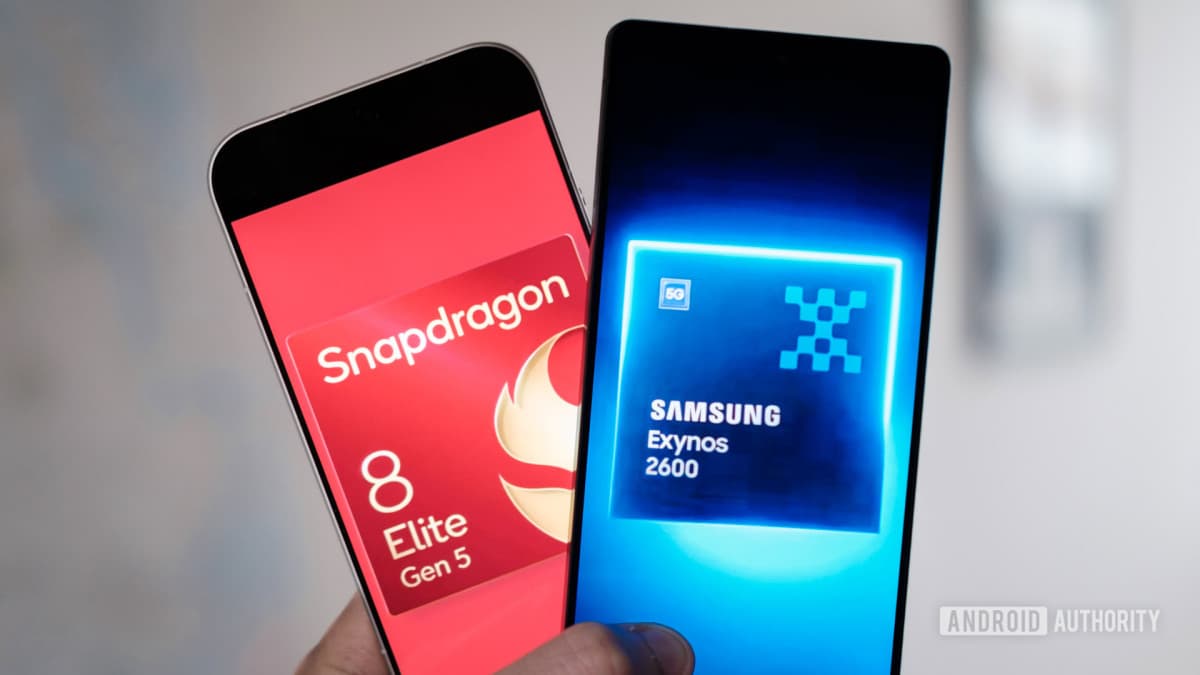
Samsung's next flagship chip, the Exynos 2700, has reportedly outscored Qualcomm's upcoming Snapdragon 8 Elite Gen 6 — and even its higher-clocked Pro variant — in Samsung's own internal testing ahead of the Galaxy S27 launch. The claims come from a report by South Korean outlet Seoul Economic Daily, picked up by Android Authority, citing industry sources familiar with the evaluations.
If the numbers hold up, this would be a reversal years in the making. Exynos flagships have long carried a reputation for running hotter and slower than the Snapdragon versions of the same Galaxy phone, to the point that Samsung dropped Exynos entirely from some generations.
The numbers Samsung is claiming
According to the report, Samsung's in-house tests measured the Exynos 2700 ahead across CPU, graphics, AI, and efficiency:
- CPU — 19 percent higher than the Snapdragon 8 Elite Gen 6 in Geekbench 6.5 multicore, and 9.5 percent higher than the Gen 6 Pro
- Graphics — 5 percent better peak performance than the Gen 6 Pro, stretching to 24 percent better in low-power gaming scenarios
- AI — 18 percent faster at generating responses from an on-device model and 5 percent faster at processing prompts
- Efficiency — roughly 12.7 percent lower power consumption than the Gen 6 Pro in simulated everyday use
The low-power gaming margin may be the most meaningful one. Sustained performance under a tight power budget — not short benchmark bursts — is what decides how a phone actually feels after twenty minutes of gaming, and it is exactly where past Exynos chips fell behind.
Which Galaxy S27 models get the Exynos 2700
Per the report, Samsung plans to ship the Galaxy S27 and S27+ with the Exynos 2700 in most markets, while the United States, Canada, China, and Japan get the Snapdragon 8 Elite Gen 6. The Galaxy S27 Ultra is expected to stay Snapdragon-only worldwide. If Samsung follows that split, units sold in the Philippines would be the Exynos versions of the S27 and S27+ — so these test results describe the exact chip Filipino buyers would get. Samsung has not announced official Philippine pricing or a launch date for the Galaxy S27 series; the S27 family is expected in early 2027, and we will know local prices closer to launch.
Why the results need caution
These are Samsung's own tests of its own chip, reported secondhand — not independent benchmarks. The company has made similar claims for previous Exynos generations that did not survive contact with retail hardware, and thermal behavior in a finished phone chassis can look very different from a test board. Samsung is said to have added new heat dispersion technology to address its history of throttling, but the honest position is to wait for reviewers to run the retail Galaxy S27 against Snapdragon units before declaring a winner.
Why Samsung is pushing Exynos again
The business logic is straightforward: Qualcomm chips are getting more expensive. Qualcomm has confirmed a Snapdragon price increase taking effect September 1, driven by the same AI-fueled component inflation that has pushed Samsung's own foundry prices up by as much as 15 percent. Every Galaxy that ships with an in-house Exynos instead of a bought-in Snapdragon protects Samsung's margins — and, in theory, gives it room to hold retail prices steadier in price-sensitive markets like the Philippines. A competitive Exynos 2700 is not just an engineering win; it is Samsung's hedge against its biggest supplier's price list.