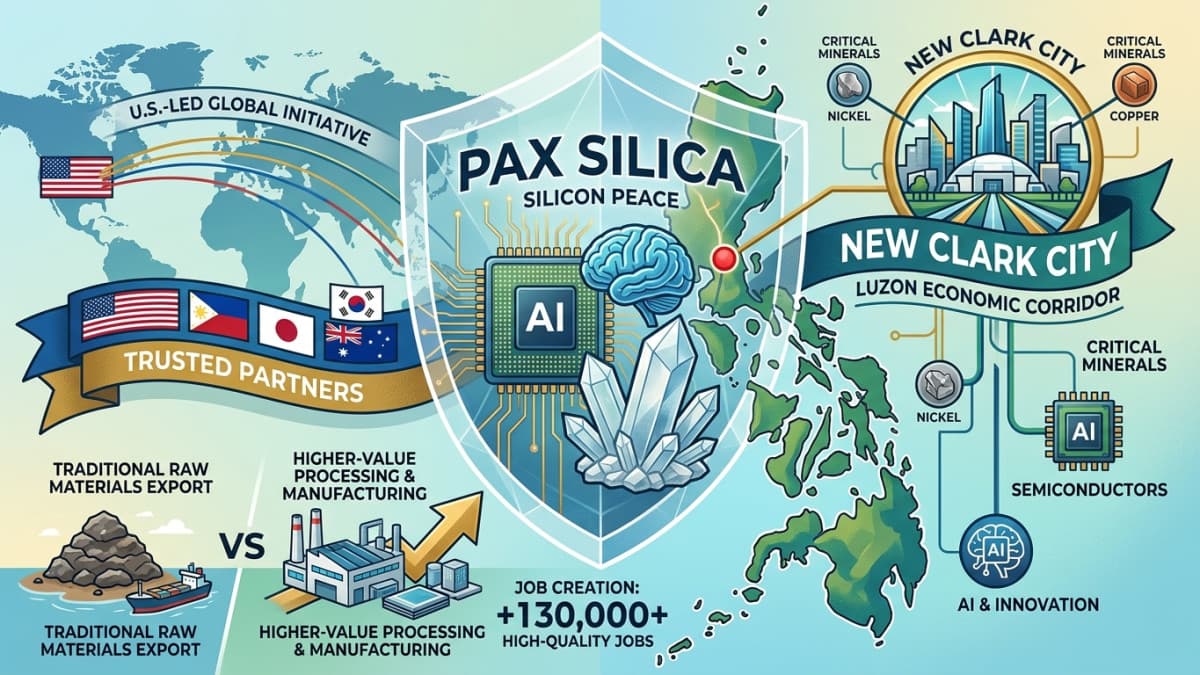
The Department of Trade and Industry (DTI) on August 25 clarified what the Pax Silica hub in New Clark City will actually be: a manufacturing site that builds hardware and equipment for artificial intelligence (AI) systems, not a campus of AI data centers. Data center facilities, the agency said, will instead go to locations with stronger power and water supply. The clarification is the government's latest response to weeks of public debate over what the country's largest prospective foreign tech investment will really deliver.
What the DTI actually clarified
The confusion is understandable. Pax Silica has been widely described as an "AI hub," which many readers took to mean server farms. Officials have now drawn the line repeatedly: the New Clark City site in Capas, Tarlac is for advanced manufacturing — processing materials and producing components and equipment that AI data centers elsewhere will use.
This matches what the Bases Conversion and Development Authority (BCDA) has been saying since early August. BCDA President and CEO Joshua Bingcang told reporters that "ang proyekto na ito ay hindi data centers" (this project is not data centers), comparing the plan to the special economic zones of CALABARZON that host electronics plants. At a Senate hearing in mid-August, DTI Undersecretary Ceferino Rodolfo explained that the actual Capas project is formally called the Clark Advanced Manufacturing Park, and that Pax Silica itself is a separate, non-binding economic agreement among 24 signatories — 23 countries and one economy — which the Philippines joined in April.
Developers must bring their own roads, power, and water
A notable new detail in the August 25 clarification: locators and developers at the site must build their own roads, secure their own power, and manage their own water — without government financial support. Officials say the self-sufficiency rule is meant to keep the project sustainable and avoid spending public funds on private infrastructure.
That design answers the loudest criticism of the project. Lawmakers and environmental groups have questioned whether a large industrial site would strain electricity and water supplies around Capas. At the Senate hearing, officials said investors would generate their own power using solar, batteries, and liquefied natural gas, and would source seawater and build storage rather than compete with households for local supply. The government's contribution is the land itself — about 1,619 hectares, or roughly 4,000 acres.
Not just New Clark City
The DTI also confirmed that Pax Silica projects will not be limited to Tarlac. Other ecozones across the Philippines are under consideration, and the agency is in talks with a Metro Manila local government about an integrated circuit (IC) design hub. Metro Manila already hosts 13 IC design sites, including four Filipino-owned firms.
The hub also has a prospective anchor tenant. iPhone assembler Foxconn has signaled interest in anchoring the New Clark City site and is conducting due diligence, as covered in our earlier report. Manila and Washington are targeting a comprehensive framework agreement before the end of 2026, a timeline we detailed when the two governments began racing to close the deal.
The numbers attached to the project
Government briefings on the program cite large ambitions: about ₱180 billion in projected annual revenue, 200,000 jobs, 3 gigawatts of power demand, and 39 billion liters of water per year across the planned developments. Those figures describe the full build-out, not what breaks ground on day one — and under the new rules, the power and water burden is supposed to fall on the developers, not on public utilities.
What this means for Tarlac and beyond
For host communities, the manufacturing-versus-data-center distinction matters in practice. Factories that build AI hardware employ far more people than data centers, which are power-hungry but thinly staffed. If the government holds the line on self-built infrastructure, Tarlac gets manufacturing jobs without absorbing the grid and water strain that data centers would bring — and the data centers go to regions that can actually supply them. The next milestone to watch is the framework agreement expected before year-end, followed by the technical, legal, and commercial reviews that will decide how much of the ₱180-billion vision becomes real.