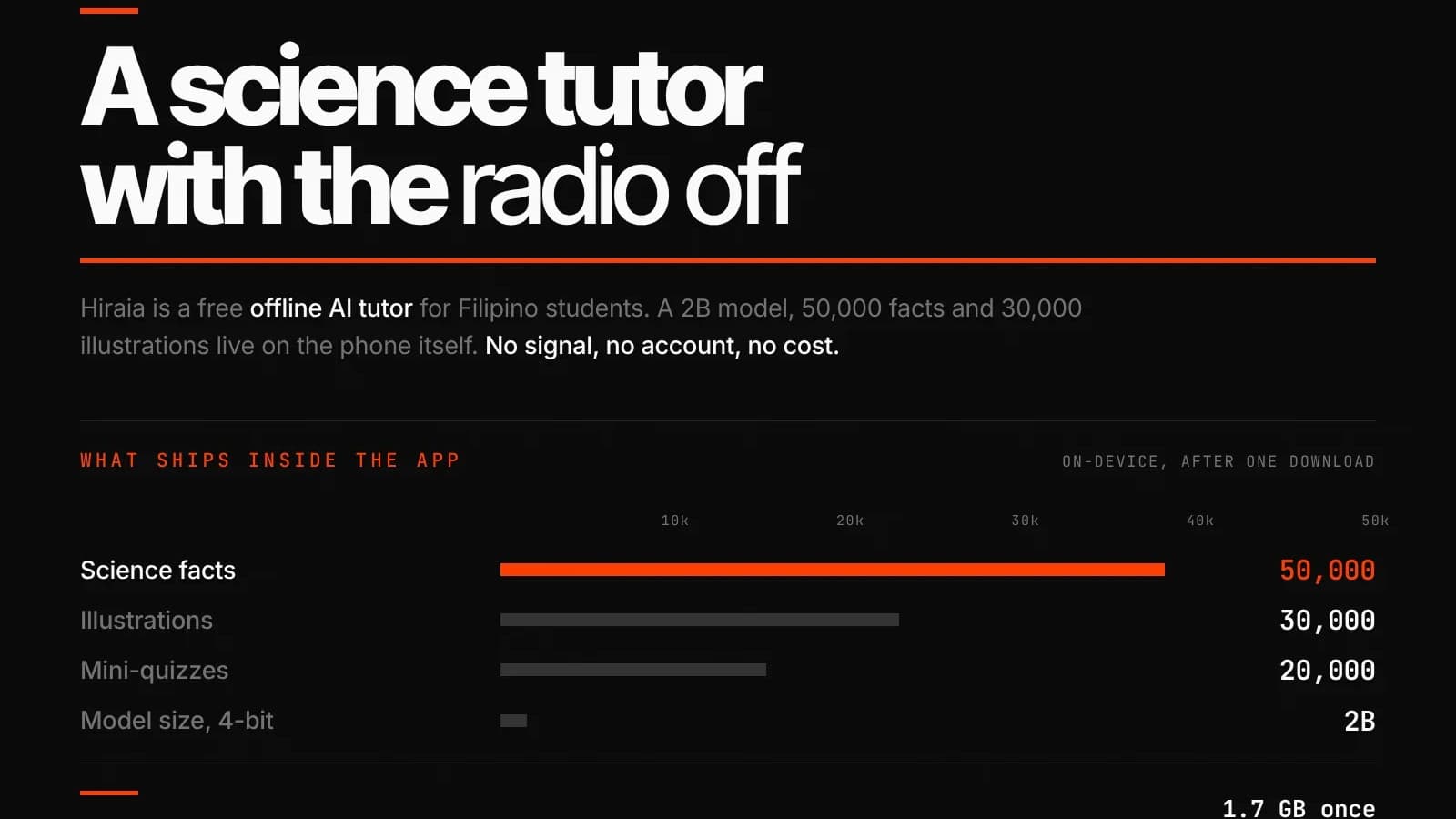
A science tutor that never needs a signal: that is the promise of Hiraia, a free AI app built by Filipino tech veteran Luis Buenaventura that runs entirely offline on budget Android phones and teaches in Tagalog, Bisaya and English. The app is in early alpha, already being piloted in a Zambales public school, and can be downloaded free at the project's site.
Built to close a measured gap
Buenaventura, who previously headed the Blockchain Council of the Philippines, has said the project started with a sobering statistic. According to The Manila Times' profile of the project, he began building Hiraia after reviewing World Bank data showing the math and science skills of an average 15-year-old Filipino student were comparable to those of a 10-year-old in Singapore.
The students furthest behind are usually the ones with the least connectivity — which is why Hiraia treats the internet as optional rather than assumed.
How an AI model fits on an entry-level phone
Hiraia packs its intelligence onto the phone itself instead of calling a server. Per the official Hiraia site, the app is built on Hiraia-2B, a retrained fork of Alibaba's Qwen 3.5-2B small language model, further trained on Filipino and Bisaya text. The download is roughly a 417MB app plus an AI model of about 2GB, and after the first launch it runs fully in airplane mode on Android 10 or newer with at least 4GB of RAM.
Two design choices stand out for Philippine conditions:
- It runs through Tether's QVAC SDK without GPU acceleration, a detail GadgetPilipinas highlighted, which keeps entry-level phones stable instead of demanding flagship hardware.
- It spreads without data. Using the Pears peer-to-peer protocol, one phone can download the full package over municipal Wi-Fi and then share it device-to-device — no cellular data spent.
Older phones that cannot run the AI model at all still get offline flashcards and quizzes.
What students actually get
The content is aimed at science learners from elementary to junior high school, aligned with the Department of Education's MATATAG curriculum competencies. The current build carries about 50,000 science facts, 30,000 illustrations and 20,000 mini-quizzes, with text-to-speech in its three languages.
The whole thing is free: no ads, no account registration, no personal data collection, and no payment. The catch is distribution — Hiraia is not on the Google Play Store, so it must be sideloaded as an APK from the official site.
Early pilots and a ₱1 million grant
Hiraia is already in classrooms in small numbers. Around 150 students across participating schools have used it, including a first pilot class of 35 pupils at Calapacuan Elementary School in Zambales on September 25. Teachers get a companion app called Tala for classroom monitoring over Bluetooth or Wi-Fi. The Tether Foundation has backed the project with a ₱1 million grant for continued model training, and Buenaventura is looking for more school partners to test the app's safety and accuracy.
Why offline-first AI fits the Philippines
Most education apps assume the connectivity their target students do not have. Hiraia inverts that: the AI is the payload, not the service. It is the same design instinct behind other locally-grounded AI work, like the Ateneo study on AI-assisted TB screening for rural health units — build for the infrastructure Filipinos actually have, not the infrastructure a demo assumes. An alpha app piloted with 150 students is not yet a dent in a national learning gap, but the architecture is pointed at exactly the students the connected ed-tech industry keeps missing.